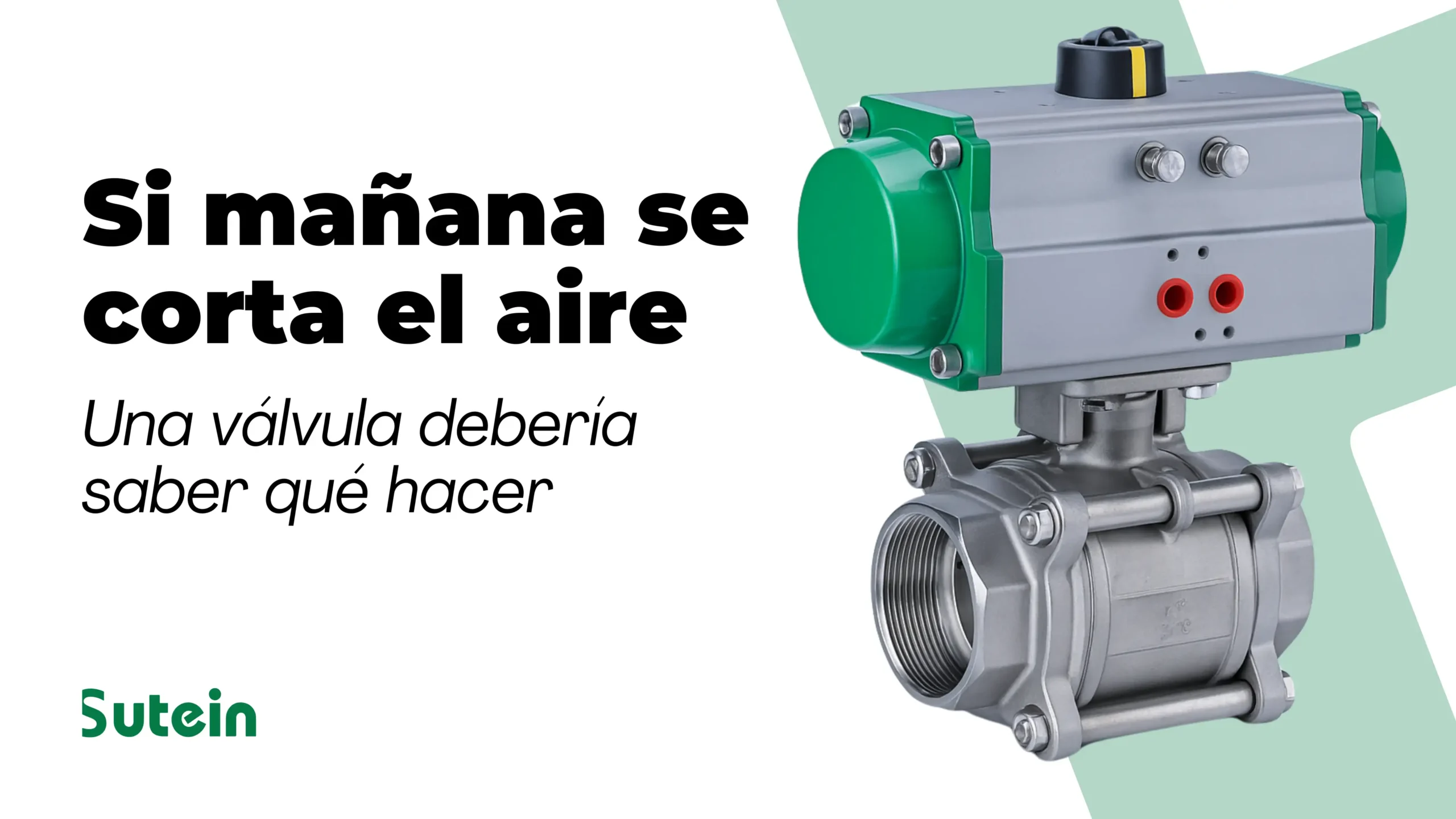
Pneumatic Actuator – Double acting vs. spring return: Which best protects your process during a power failure?

If the air supply cuts off tomorrow, a valve should know what to do.

In valve automation, choosing the right type of pneumatic actuator not only determines how the valve moves, but also how it reacts in case of failure — particularly during an air or power outage.

This difference, often underestimated, can be critical to ensuring plant safety, process continuity and product integrity.

What is a pneumatic actuator?

A pneumatic actuator converts compressed air energy into mechanical motion to open or close a valve.
In STN-AIR actuators, movement is achieved through a rack-and-pinion mechanism combined with pistons and, in some cases, return springs.

STN-AIR actuators are compact, reliable and designed to comply with international standards such as ISO 5211 and NAMUR, making integration straightforward.

Double Acting (DA) vs. Spring Return (SR)

Double Acting (DA):

  • Air is supplied alternately to open and close.
  • Requires air in both directions.
  • If air supply fails, the valve stays in its last position.
  • Recommended for:
    • Critical process lines
    • High-frequency cyclic applications

Spring Return (SR):

  • Air is required only for one movement (open or close).
  • In case of air failure, the internal spring returns the valve to its safety position.
  • Fail-safe position can be configured as normally open or normally closed.
  • Recommended for:
    • Hygienic or critical processes
    • Steam, chemical or sensitive applications
    • Systems where loss of air cannot leave the valve uncontrolled

What happens during an air or power cut?

That’s where actuator type makes the difference:

  • With Double Acting, the valve remains stationary.
  • With Spring Return, the valve automatically moves to its pre-set safety position — essential in food, pharma or hazardous-fluid processes.

Example

Imagine a valve controlling a line at 160 °C. In case of failure, would you want it open, closed or halfway?

A Spring Return actuator guarantees that, even without air, the valve returns automatically to its configured safety position — normally closed (to prevent leaks) or normally open (to maintain flow).

What does Sutein offer?

At Sutein, we configure, assemble and test every valve + actuator set according to each client’s process requirements.

  • Real torque pair evaluation
  • Product, pressure and temperature validation under standards
  • Technical recommendation for DA or SR configuration
  • Immediate mounting thanks to our in-stock components and in-house workshop

Conclusion

Choosing between Double Acting and Spring Return is a key decision impacting operational safety, system reliability and emergency response.
If you’re automating valves or reviewing existing equipment, our team will help you select not only what works — but what protects your process when it matters most.

If you’d like more technical information or help choosing the most suitable valve for your process, get in touch — we’ll be happy to help.